
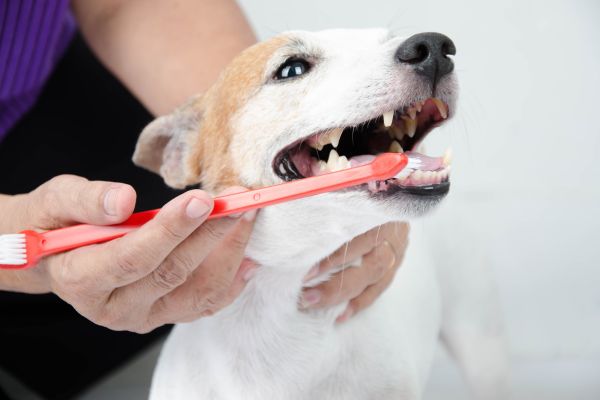
Your dog’s smile is more than just adorable—it’s an important part of their overall health. Dental disease is one of the most common (and often overlooked) conditions in dogs. Here’s what you need to know about keeping your pup’s teeth healthy.
I Was Unaware That Dogs Have Dental Problems. Is It Common?
Dental disease is one of the most common medical conditions seen by veterinarians. Over 68% of all dogs over the age of three are estimated to have some form of periodontal or dental disease.
“Few pets show obvious signs of dental disease.”
Few pets show obvious signs of dental disease. It is up to the pet’s family and veterinarian to uncover this hidden and often painful condition.
Are Dental Problems the Same in Pets and People?
No. In men, the most common problem is tooth decay, which, due to the loss of calcium from the enamel, results in painful, infected caries (also called cavities).
In the dog, tooth decay represents less than 10% of all dental problems. The most common dental problems seen in dogs are caused by periodontal disease.
What Is Periodontal Disease?
Periodontal disease is a term used to describe inflammation or infection of the tissues surrounding the tooth. Accumulation of tartar and calculus on the teeth causes gum recession around the base of the tooth. Infection soon follows, and the gums recede further, exposing sensitive, unprotected tooth root surfaces and the bony tooth sockets.
Left untreated, the infection spreads deep into the tooth socket, destroying the bone. Ultimately, the tooth loosens and falls out.
Is Periodontal Disease Very Common?
It is estimated that more than two-thirds of dogs over three years of age suffer from some degree of periodontitis, making it by far the most common disease affecting our pet dogs.
How Does Tartar Form and Why Is It a Problem?
The mouth is home to thousands of bacteria. As these bacteria multiply on the surfaces of the tooth, they form an invisible layer called plaque or biofilm. Some of this plaque is removed naturally by the dog’s tongue and chewing habits.
If allowed to remain on the tooth surface, the plaque thickens and becomes mineralized. Mineralized plaque forms tartar, and as the tartar thickens further, it becomes calculus. The tartar accumulates above and below the gumline and presses on the gums, causing inflammation called gingivitis.
As the oral infection progresses, tonsillitis and pharyngitis can also occur. The bacteria can also be absorbed into the bloodstream and carried to other organs. “Bad teeth” can cause infections in the heart valves (endocarditis), kidneys and/or liver.
Can Tartar Be Prevented?
Plaque becomes mineralized in some dogs much quickly than in others.
“The best way to prevent tartar build-up is regular home care, particularly tooth brushing…”
The best way to prevent tartar build-up is regular home care, particularly tooth brushing using toothpaste that is specifically designed to be swallowed.
Special dog chew toys and treats may help reduce or delay tartar build-up. Some pet foods have been specifically formulated as dental diets that mechanically assist in plaque removal.
Will Feeding Dry Food Remove Tartar?
Pet food manufacturers have recently developed new dental diets that can help reduce the formation of plaque and tartar in your pet. Once tartar has formed, it will be necessary to remove it by professional scaling and polishing under general anesthesia.
What Is Involved With a Routine Dental Cleaning?
A routine dental cleaning involves a thorough dental examination, followed by a dental scaling and polishing to remove the tartar and invisible plaque from all of the tooth surfaces.
Your veterinarian will perform pre-anesthetic blood tests to ensure that kidney and liver function are satisfactory for anesthesia. Sometimes, antibiotic treatment is started before the periodontal therapy is performed. Your veterinarian will discuss the specific pre-dental recommendations for your pet.
Once your dog is anesthetized, your veterinarian will:
- Examine the mouth, noting tooth alignment and tartar accumulation.
- Remove tartar with hand scalers and ultrasonic tools, including below the gumline.
- Polish the teeth to smooth microscopic scratches and prevent plaque build-up.
- Apply special treatments (fluoride, antibiotics, or cleaning compounds) if indicated.
If periodontal disease is severe, it may not be possible to save badly affected teeth, which may need extraction.
Because the extent of disease can be hard to predict in advance, it is imperative that your veterinarian can reach you during the procedure to discuss any additional treatment that may be necessary.
Why Can’t I Just Remove the Tartar and Plaque With a Dental Scaler?
Although you can remove the tartar that has accumulated above the gumline in some very cooperative dogs, there are three problems with this:
1. Only the tartar above the gumline is removed, leaving disease-causing material below the gumline.
2. It is not possible or safe to clean the inner surfaces of the teeth properly in a conscious dog.
3. Instruments can cause microscopic scratches on enamel, leading to more disease.
(This is why your dental hygienist always polishes your teeth after removing tartar with instruments.)
Do I Have to Make an Appointment for My Dog to Have a Dental Scaling and Polishing?
Yes. Your veterinarian will perform pre-anesthetic blood tests, examine your pet for any other underlying disorders, and determine if antibiotic treatment should be started in advance.
How Can I Prevent Tartar Accumulation After the Procedure?
“Plaque and tartar begin forming in as little as six hours after your pet’s dental cleaning.”
A home dental care program, including regular tooth brushing, is a must for all pets. Your veterinarian will provide you with detailed instructions on how to brush or rinse your pet’s teeth.
Can I Use Human Toothpaste?
Absolutely not. Human toothpaste should never be used in dogs. Many human products contain xylitol, which is safe for people but highly toxic for dogs.
Even if there is no xylitol, human toothpastes are foaming products not intended to be swallowed and can cause internal problems. They also often contain higher sodium than your pet requires.
You should also avoid baking soda. It can upset the stomach if swallowed and has an unpleasant taste that makes dogs resistant to brushing.
Why Is Pet Toothpaste Recommended?
Pet toothpastes are non-foaming, safe to swallow, and come in dog-friendly flavours like poultry, beef, malt, or mint.
Because they taste good, your pet may enjoy the process more. Many also contain enzymes that help chemically break down plaque, reducing the amount of time you need to spend brushing.